




Same-Sex Marriage Ten years on - Reformed Magazine
Reformed looks back with John Bradbury, URC General Secretary
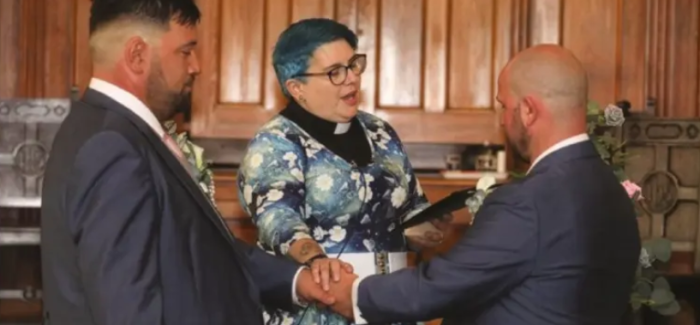
It is ten years since the United Reformed Church, at the 2016 General Assembly, became the first mainstream Christian denomination in the UK to allow churches to offer same-sex marriages. The decision followed two years of consultation and debate, after a similar resolution had failed at the 2014 Assembly.
But the story for the URC goes back further, to the 1990s, when the Church was drawn into years of irresolvable debate on sexuality – specifically, over whether to ordain gay and lesbian ministers. Opinions proved so deeply rooted, on either side, that debate never seemed to change anyone’s mind.
Any resolution where one side won and the other lost would cause pain, division and damage. But any kind of consensus or compromise seemed impossible: either the URC allowed gay people to be ministers or it did not.
And so one attempt after another to steer the Church through the debate failed. Eventually a way through was provided by the ‘Commitment on Human Sexuality’, brought to Assembly by Malcolm Hanson, founding Chair of GEAR, in 2007. In this, the URC pledged to make no denominational policy decisions on sexuality, so decisions on whom to ordain would be made locally; and members were to accept those in disagreement as brothers and sisters in Christ.
When Scottish and UK laws were passed introducing same-sex marriage, and it became clear the Church would again have to decide whether to say yes or no, some responded with bruised battle-weariness. Things were relatively simple in Scotland, where registered celebrants could conduct weddings anywhere; but in England and Wales, marriages could only take place in registered buildings, so the URC had to decide whether to permit churches to register.
The Revd Dr John Bradbury, now General Secretary of the URC, was, as a young minister, part of the task group behind the Commitment that Hanson brought to the Church in 2007. John reckons that, though that earlier debate may have exhausted the Church, it also left it rather well prepared.
‘That Commitment brought us to a place that has held us ever since, I think. And those debates were not easy at all, but the foundation work of that Commitment meant that we had a common understanding ARS about how we were going to live together with this. An understanding that different views could be held in good conscience in the life of the Church. An understanding that how that then played out was in the hands of local church meetings. That gave us the building blocks on which we were able to respond to the question on same-sex marriage. In the end, it was nowhere near as difficult as it would have been if we hadn’t got those building blocks in place.’
The resolution on same-sex marriage brought to the 2014 Assembly was to give churches in England and Wales permission to register for same-sex marriages if they wished, and permission to uphold a traditional view of marriage if that…
Subscribe to digital Reformed for access to this article and our archive dating back to 2013.


Submit a Comment