


A good question: What difference did Pope Francis make? - Reform Magazine
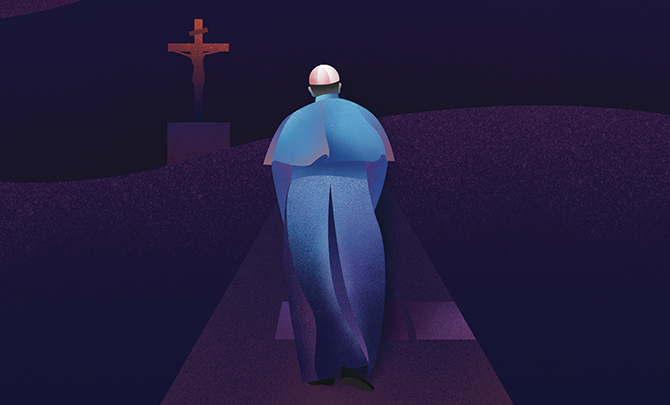
One question, four answers
Dominic Robinson
‘He was a true builder of bridges’
We are not living an era of change but a change of era.’ Francis’s comment in 2015 became a mantra for his papal ministry in a fast-changing world where the Catholic Church had lost so much credibility and needed to be humbled back to simplicity. His choice of name said it all, defining reform by a style, like St Francis of Assisi, of living simply, attuned to the poorest on the peripheries and caring for the beleaguered planet.
Jesuit formation taught Francis how to discern the signs of the times and to respond as a sinner who knows he is loved by God. His response to a journalist’s question on homosexuality, ‘Who am I to judge?’, was the fruit of such discernment. That pastoral heart taught him that marital break-up and falling in love again required first compassion from the Church, not condemnation. He had once been an authoritarian Jesuit superior but learned servant leadership in listening carefully and from building consensus…
Dominic Robinson is Parish Priest of Farm Street Church, Mayfair, and Vice Chair of the Society for Ecumenical Studies. This article appeared, in longer form, on the Redemptorist Publications website
___

Lindsey Sanderson
‘He offered prophetic leadership on the climate crisis’
As a member of the Roman Catholic-URC Dialogue Group, I became more attentive to the writing of Pope Francis. As I reflect upon the difference he made I turn to his words.
Laudato Si’, Francis’s second encyclical, published 24 May 2015 and subtitled ‘Our care for our common home’, brought the environmental crisis to the fore in theological reflection and practical action. It brought together biblical/theological reflection with the need to engage with ecology, science, and global/national political systems. Francis highlighted the needs and perspectives of the global south and indigenous peoples. The timing of the encyclical, just a few months ahead of COP21 in Paris, gave added impetus to people of faith to engage with COP and the decisions we hoped it would take…
Lindsey Sanderson is the Moderator of the United Reformed Church National Synod of Scotland
___

Philip Brooks
‘I was surprised by my grief’
I was on a road trip from the north of England back to London on Easter Bank Holiday Monday. It was still early in the day and the radio was on in the car, accompanying me on the long journey home. Out of the blue came the newsflash announcing that Pope Francis had died. It was a matter of only a few hours after he had made an unexpected Easter Sunday appearance in St Peter’s Square to bless the gathered crowds.
What took me by surprise was my immediate sense of grief and loss at the passing of this extraordinary man who, as the first Latin American and Jesuit Pontiff, had sought to redefine the Catholic Church….
Philip Brooks is Deputy General Secretary (Mission) for the United Reformed Church until July.
___

Tina Beattie
‘A new participatory model of Catholic life’
Until the election of his successor, this was an anxious question for many of us: Did Pope Francis make a difference, or was he a visionary one-off in scuffed old shoes and simple attire, walking the walk as well as talking the talk, but perhaps of no enduring significance in the long and messy history of the papacy? With the election of Peruvian-American Robert Prevost as Pope Leo XIV, it seems likely that Pope Francis’s reforms will indeed become a catalyst for continuing transformation. More conservative in dress and doctrine than Pope Francis, Leo XIV has nevertheless already positioned himself as fully committed to continuing the vision of his predecessor, speaking out for all who are poor and marginalised in our ruthless modern socio-economic order, and reiterating Francis’s words that we are facing ‘the tragedy of a third world war in pieces’….
Tina Beattie is Professor Emerita of Catholic Studies, University of Roehampton
___
This is an extract from an article published in the Issue 4 – 2025 edition of Reform


Submit a Comment